Q-SYNQ® - Performance by Reality
« What if the problem weren't your procedures, but the gap between what is written and what is actually lived? »
Why your improvement initiatives eventually run out of steam
Lean, WCM, PDCA, DMAIC, 8D: these tools come from the engineering sciences. Their limit is not a failure of execution, it is structural.
They describe an ideal, never the real, and make « humans serve the machine ». Once the consultant leaves, the initiative fades away.
« Here comes yet another quality expert about to walk us through some umpteenth project… and once he's gone, it'll die. »
The stated symptom
« Here's what's wrong, fix it. »
The real problem
Often elsewhere - in what plays out between people.
The prescribed is not the real
A procedure or an org chart describe an ideal way of working - never the real one.
« An orchestra doesn't play the score, it interprets it. »
The gap is irreducible, and necessary: applying 100% of procedures means working to rule. It is people's discretionary effort that produces quality. This is what grounds Performance by Reality.

« Applying 100% of procedures means working to rule. »
A scientific method, not a recipe
No copy-paste. With Durkheim, the primacy of the social: collective solutions outweigh individual ones. Q-SYNQ brings together the engineering sciences and the human sciences - uniting them, not opposing them - for a « 3D » view of the organisation, backed by a network of PhDs in sociology and anthropology.
Strategic analysis
Crozier, Friedberg
Power is the mastery of a zone of uncertainty - not a place on the org chart.
Sociology of organisations
Dupuy
Bureaucratisation at work: more procedures, more reporting, more indicators.
Anthropology
What makes an organisation: its culture, its beliefs, its rituals.
Psychodynamics of work
Dejours, Clot
The link between the quality of work and the engagement of those who do it.
Hover or tap a pillar to expand it
How we work
Two views of what exists advance in parallel - the prescribed and the real (AS IS) - then converge to build the TO BE, from step D onward.
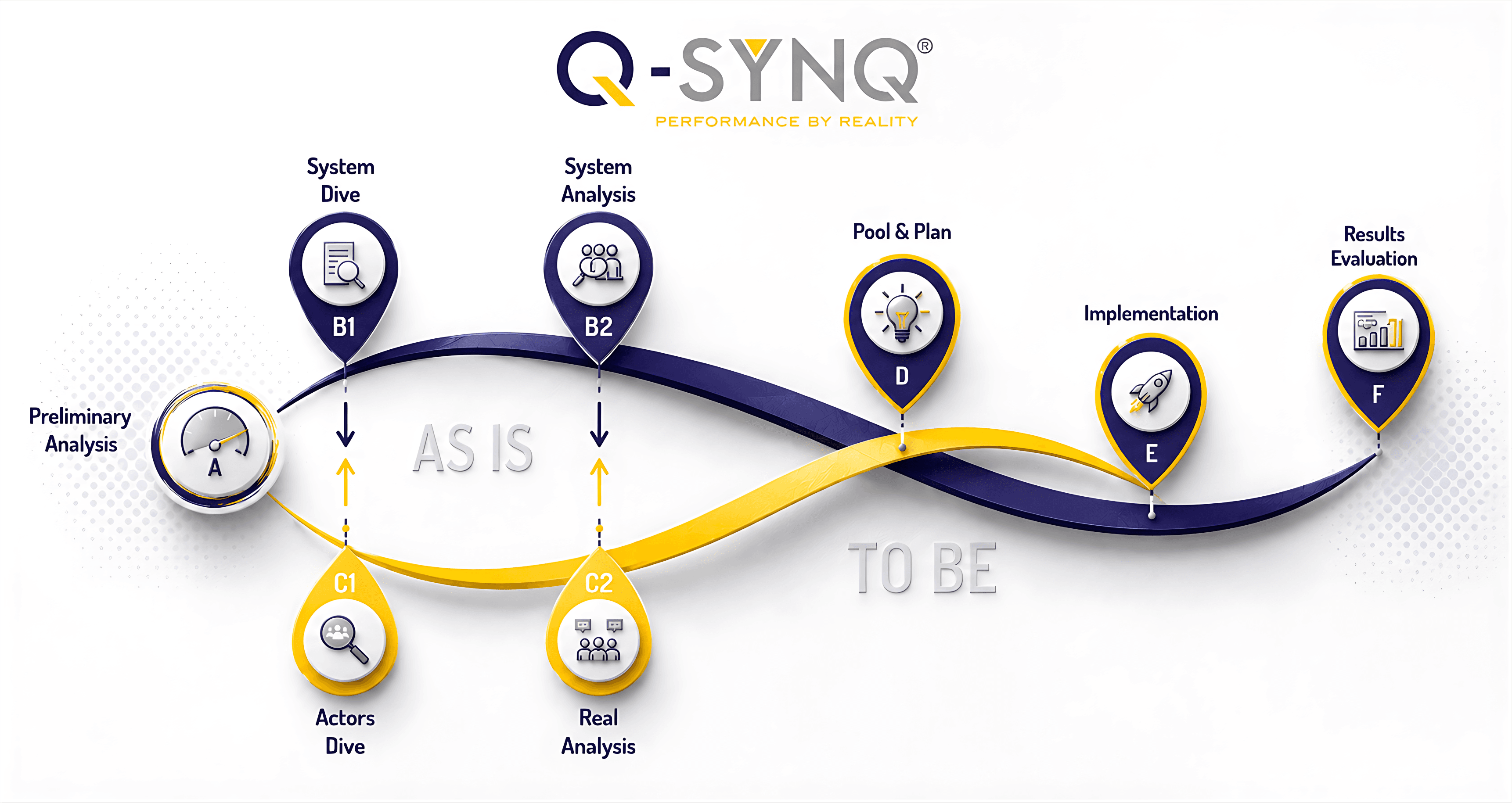
Tap a marker, or browse the 8 steps below.
This is not an audit
An interview is not an audit. An audit checks compliance. The interview, by contrast, reconstructs the real: « it's almost an art » - the interviewer's craft (Bourdieu), the stage and the wings (Goffman).
« An audit is something else. There is no comparison to be made. »

What it looks like in the field
Three real, anonymised situations. The same thread each time: a stated symptom, what we discovered, then the outcome.
Stated symptom
HR tensions, turnover, recurring conflicts between several sites.
What we discovered
The sites had deliberately cut ties to preserve their autonomy: a play of actors, not a failure to follow procedure. A purely normative reading would have wrongly penalised them and done « more harm than good ».
The outcome
Naming what was really resisting brought immediate relief to the organisation.
Stated symptom
An SME wanting to « get structured around ISO 9001 », against a backdrop of high turnover.
What we discovered
A co-built overhaul: the processes were written WITH the people, in collective regulation.
The outcome
Almost no more turnover.
Stated symptom
A request for e-learning on special processes: « procedures aren't followed on the shop floor, we need to raise operator awareness to improve compliance ».
What we discovered
Behind the request, a belief inherited from Taylorism: compliance would come from the strict application of procedures. Yet the problem wasn't a lack of knowledge, but of recognition: the operators held practical know-how essential to how the processes actually work, ignored by the organisation. During a previous training session, they had walked out of the room: « you can't explain our job to us without understanding our work ».
The outcome
Unsurprisingly, the e-learning changed nothing. As long as an organisation treats a cooperation problem as a compliance problem, it produces the same result: the same deviations, the same audits, the same findings.

Does your situation look like this?
Let's talkQuality of work, the primary driver of engagement
The main factor in psychosocial risk is being prevented from doing quality work (Dejours, Clot): work « neither done nor to be done ». Beautiful premises change nothing. Q-SYNQ is not just a diagnosis: it is a change-management tool.
« The very act of questioning an organisation already sets change in motion. »
The full conversation with Grégory Charpentier
Designer of the Q-SYNQ method, head of QALIA Performance.
Go further with the method
 PDF
PDFQ-SYNQ® reference document
The complete methodology document.
Download the PDFPDF · 8 pages · free download
Let's talk about your organisation
A question, a project, a situation that resists? Let's talk.
Contact us